
Paint over a crack and you buy it straight back.
Cracks get opened up, filled, textured to match the wall and sealed, so the repair does not telegraph back through the finish six months later.
Why Florida stucco cracks
Almost every house here is block with stucco over it, or frame with stucco on lath. Both move. The ground is sand and the house settles into it, the sun heats one wall to well past a hundred degrees while the shaded wall stays cool, and the block and the stucco expand at slightly different rates. Something gives, and what gives is the finish.
The usual places are the corners of windows and doors, where the opening concentrates the stress, and along the control joints the builder cut in for exactly this reason. Hairline cracking at those spots is normal on a Florida house. It is a maintenance item rather than an emergency.
What turns it into a real problem is water. A crack is an opening, and wind driven rain gets pushed straight into it. Once water is behind the stucco it goes to work on whatever it finds, and the first thing you usually see is paint blistering outside or a stain that keeps coming back on the inside wall.
- Every elevation walked and the cracks marked before we quote
- Cracks opened so the filler has something to key into
- Texture matched to the wall around the repair
- Window and door perimeters recaulked, not painted over
- Repairs sealed and primed before any finish coat
How a crack actually gets fixed
The crack gets opened up first. Running filler over a tight hairline leaves a thin skin of material with nothing to grip, and it splits again along the same line the first hot week. Opening it out gives the patching material a shape to hold onto, and that is the difference between a repair and a smear.
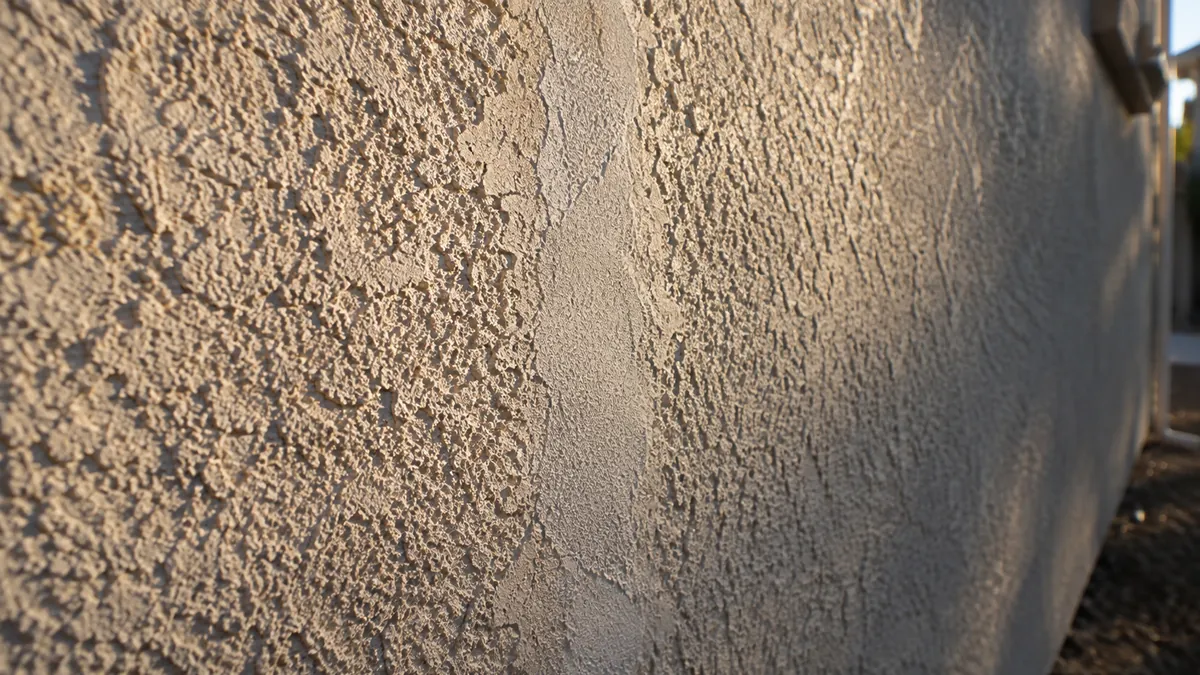
Then it gets filled with the right material for that wall, pressed properly into the opening rather than floated across it, and cut back level. After that the patch gets textured. Walls around here carry knockdown, sand finish, dash and everything in between, and a smooth patch on a textured wall is visible from the street even after it has been painted, especially in morning light.
Last comes sealing and priming, so the finish coat lands on one consistent surface. A patch that never got primed drinks paint at a different rate to the wall beside it and shows up as a dull shape through the color no matter how many coats go over it.
Caulk, and the joints nobody looks at
Caulk is the other half of sealing a house. Around every window and door frame, where the garage opening meets the wall, where two materials meet, and at every penetration for a hose bib or a light fixture, there is a bead of caulk doing real work. It is also the first thing on the outside of a house to dry out and split.
Old caulk gets cut out instead of painted over. Paint on top of a split bead lasts about as long as it takes the sun to move that joint again, and the whole point of the material is that it stays flexible. Fresh caulk goes into a clean joint and gets tooled in so it actually contacts both sides of the gap.
This is unglamorous work and it is most of the reason an exterior paint job either holds up or does not. It is also why sealing shows on the estimate as its own line, so you can see what you are paying for instead of finding it buried inside a square footage number.
When a crack is not a painting job
Some cracks are structural and no coating fixes those. A stair step crack following the mortar joints through block, a crack that is wider at one end than the other, a horizontal crack running along a wall, or one where the two sides no longer line up. Those are movement in the house rather than movement in the finish.
If we find one we will show you a photo of it and say plainly that somebody qualified should look at the structure before anybody paints anything. Filling it and coating it makes it invisible for a season and hides a problem that is still going on behind the paint.
The same goes for a wall that is wet. If water is coming in from a roof, a gutter, a failing window seal or dirt graded too high against the slab, that has to be dealt with first. Painting a wet wall is money spent on a coating that will blister off it.
Got a crack you have been watching get longer?
Send us a photo and we will tell you what it is.
What 24 homeowners said
Every quote below is a real review, word for word, from our Google profile.
I hired them to paint the exterior of my home, and I couldn’t be happier with the results. The team was professional, punctual, and paid attention to every detail. The finish looks flawless, and the house feels brand new again! Pricing was fair, and communication throughout the project was excellent.
I contracted him to paint my 2 story home. He took care of every little thing that needed to be done and the final challenge was doing a walk through with my wife and he did everything to accommodate her. Great job, fair prices, great communication. Went the extra mile.
Innova Pro Painting and Services did an amazing job painting our dining room, living room, and the entire exterior. They provided a fair and transparent quote, showed up exactly on time, and finished the project within the estimated timeline.
Outstanding work from start to finish. Extremely professional, detail-oriented, and efficient. The final result exceeded my expectations and completely transformed the space.
Jeffery and his staff did a superb job concerning the complete remodel and painting for our immediate town home neighbor. My wife and I would always recommend Jeffery and his amazing team for any type of painting or remodeling work.
Hard to find good honest prompt affordable contractors these days. Completed our job literally within 48 hours. Highly recommended.
Free look at every crack on the house, with photos of what we find.
A crack that was opened, filled, textured and sealed holds far longer than one that was coated over, and on a wall with a lot of fine cracking an elastomeric coating bridges the movement as well. Houses keep moving, so nobody can promise you never see another one.
Usually very close. Knockdown, sand and dash are all matchable by hand. The hardest one to hide is a repair in the middle of a big flat wall in full sun, and we will tell you up front how close we expect to get.
At least out to the nearest break. A patch painted as a spot leaves a different sheen and a slightly different color, so we take the coating to a corner or a control joint where your eye already expects a line.
Width, direction and offset. A hairline at a window corner is normal. A stair step crack through the block, a crack wider at one end, or two sides that no longer line up is different. Send a photo with a pen next to it for scale and we will tell you what we think.
Yes, though we will prime the repairs so they are not left open to the weather. Some people want the wall sealed now and the painting done later, and that is a sensible way to split it.
Chipped corners, damage around a hose bib and holes left behind by an old satellite mount all get patched and textured the same way a crack does.
It stops water coming in through the cracks and joints we sealed, and that is where most of it comes from. It will not fix a leaking roof or a window that is failing, and we will tell you which one you have.
Repair and sealing show as their own lines on the estimate so you can see what each one costs. It happens before the coating either way, because it is the part that decides how long the paint lasts.
Get a free estimate.
Tell us what needs painting. We come and look at it and put a real number on it.